Start a Twitter research shortlist with the question you need to answer. Find accounts through the organizations and people responsible for that subject, check representative posts, and give each source a reason to be included. You can then decide whether an X List would make that set easier to follow.
Here is a small example for someone researching space-telescope images. The output is a source shortlist with three different roles and a clear gap to fill. It is a practical starting point you can reproduce for another subject.
Define what you need to learn
“Space accounts” is broad enough to include mission announcements, amateur images, science reporting, and entertainment. A narrower question gives you a way to choose between them. For example, where can I find the original explanation and credit for a shared space-telescope image?
That question suggests three requirements. You need a route to the originating mission, enough background to understand the image, and a way to identify its credit and associated release. Follower count does little to resolve those requirements.
Write the question at the top of your shortlist. Add a column for the role each account will serve. A popular account can be relevant, but its popularity should not be the reason that occupies that column.
Find accounts through an authoritative directory
An organization's own website is a useful starting point for checking which social account belongs to it. For this example, we checked NASA's social-media directory on November 13, 2026. It linked the NASA, NASAWebb, and NASAHubble accounts.
That establishes an affiliation signal. It does not make every statement equally relevant to our question. We also checked the NASA organization page, the Webb mission page, and the Hubble mission page to understand the roles behind the accounts.
Use the same approach in another field. A university directory can help identify a laboratory's account. A publication's staff page can help connect a reporter with an employer. Keep the verification URL beside the handle so that you can revisit it when an account changes its name or affiliation.
For the identity-checking step, the official-account checking guide explains how to compare a profile with its organization’s own links.
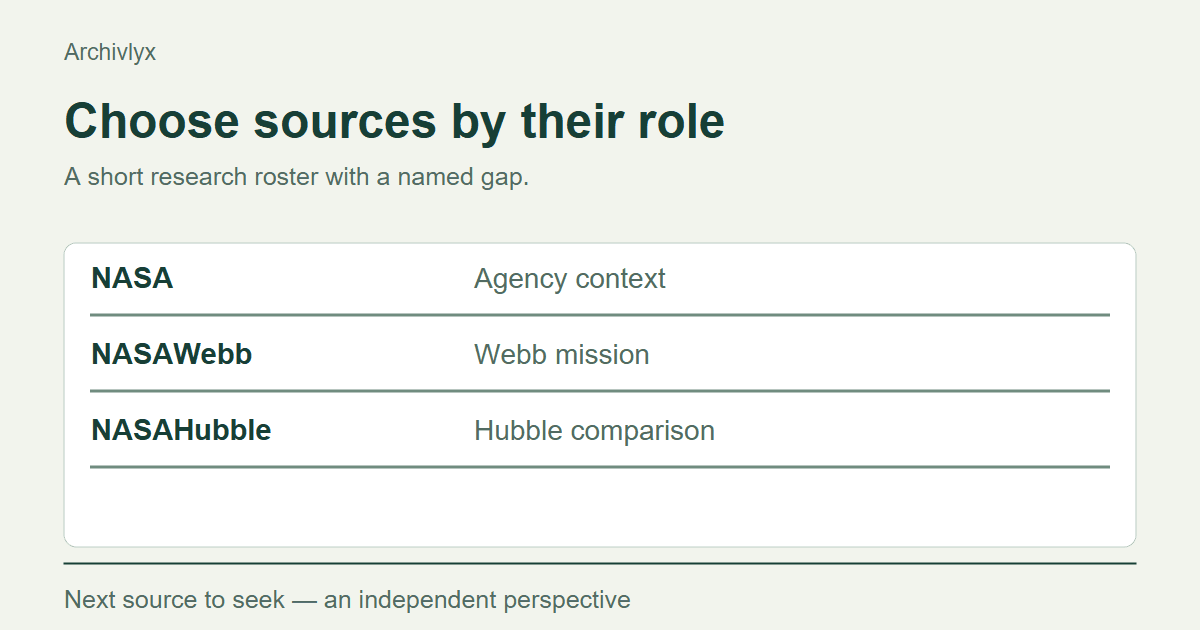
A completed three-source shortlist
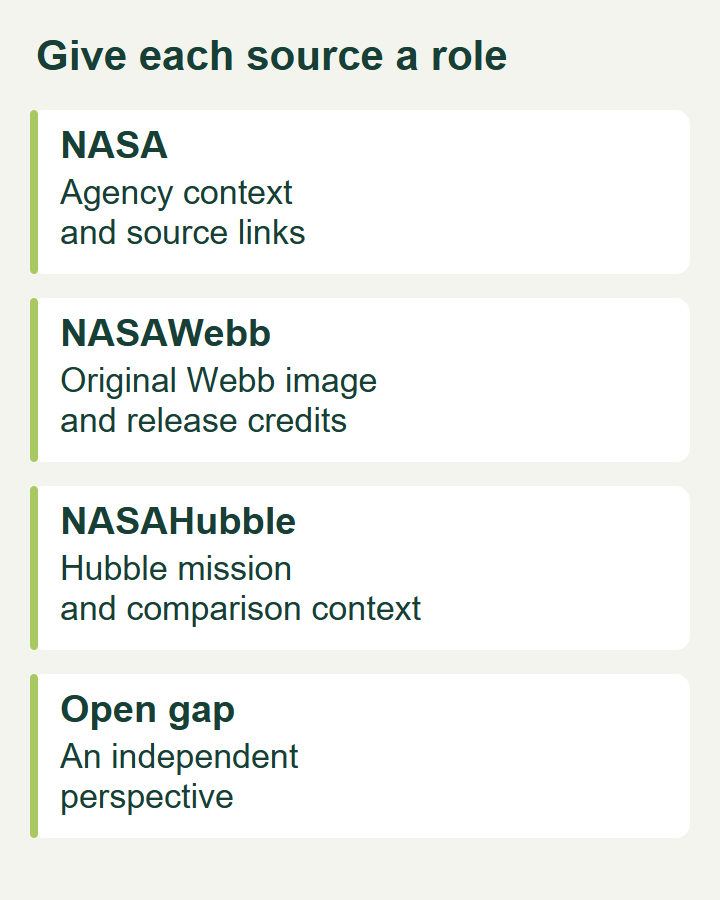
NASA — agency context. Keep this account for broader mission announcements and routes to official resources. For a specific telescope image, follow the post's link to the originating mission or release.
NASAWebb — Webb-specific material. Use this account as a discovery route for Webb images and their scientific explanations. Record the linked release as the source for the image's meaning and credit.
NASAHubble — Hubble-specific material. Use it for Hubble releases and relevant comparison background. Its role becomes especially useful when your question involves observations from more than one telescope.
Representative sources checked for this shortlist include NASA’s first deep-field image release, NASAWebb’s post sharing the first deep-field image, and NASAHubble’s post pointing to a gravitational-lens image. These historical examples were inspected for this article. They demonstrate routes to original explanations and image material, while current posting frequency requires its own check. The two Webb references concern the same release, so retain the mission account as the more specific discovery source and use the agency page for its full explanation.
These roles come from the checked affiliations and mission pages. They describe why the accounts belong in this example. They do not rank the accounts by scientific quality or promise that every post will answer the research question.
Check posts before treating an account as a regular source
Open a few posts relevant to your question. Does the account link to the original release? Can you locate the author or organization, date, and image credit? Does the linked material explain the claim you would want to reuse?
When you already know a handle, the Archivlyx Profile Viewer provides an additional public-profile entry. Use the organization’s directory to check affiliation, then follow the representative posts and their sources for the research question.
For the shortlist itself, record the candidate's handle, affiliation-check URL, role, representative post URL, and review date. Add a note explaining whether the candidate stays, needs further checking, or is outside the current question.
You do not need to collect a large account set to begin. Three sources with distinct jobs can reveal what is missing more clearly than a long list of similar accounts.
Look for the gap in the shortlist
Our example contains three affiliated official sources. It would benefit from an independent scientific or reporting perspective when the task involves interpreting a disputed claim or comparing coverage. That is a named next research step.
Keep different roles visible. An official announcement, independent reporting, and expert commentary may all help, but they support different kinds of statements. A repost of the same release adds a discovery route without adding an independent observation.
Professional researchers also use lists to discover people working in a field. Bellingcat's research introduction describes Twitter lists as one way to find researchers. Treat another person's list as a set of candidates you can inspect and adapt.
Decide whether to move the shortlist into X Lists
The file is already useful as a research record. If you want to read these accounts together inside X, review the platform's current Lists instructions, including its public and private choices, and create the list in the account you intend to use.
This worked example ends with the shortlist. When you create your own list, its name and description can retain the original question so the selection remains understandable. Keep the verification notes outside the live feed, where they can record why an account was included.
Revisit the shortlist when the project changes. Remove sources that no longer serve the question, add the missing perspective, and update affiliation checks when needed. The useful result is a set you can explain and use in the next stage of the research.