To save a Twitter thread for research, keep an ordered record of the posts you need, with a separate source URL for each one. Add a short summary and a note about any media you have actually saved. Bookmarking an opening post is useful for returning later, but it doesn't give you an offline copy of the whole conversation.
The choice depends on what you want to do next. Reading tomorrow needs a return link. Citing an argument next month needs its sequence and sources. Watching a clip offline needs the media file. A useful saved thread makes those differences visible instead of calling everything an archive.
Choose the result you need
Start with the smallest output that serves your task. You can keep more than one, but each should have a clear job.
Return to a conversation: keep a bookmark or saved post link. Check that you can reopen the specific post and connected replies when you need them.
Cite a short thread: make an ordered research note with individual URLs. Check that the author's qualifications and source links remain attached to the right point.
Read a fixed page later: keep a PDF of the content actually printed. Compare the preview and resulting pages with every post you intended to keep.
Use a clip or image offline: keep a separate media file plus its post URL. Open the file and check which post it belongs to before using it.
X's bookmark instructions describe saving posts for later access. They aren't a promise that bookmarking one post downloads the other posts or their media. Likewise, a browser's print function saves what reaches its print layout. Check that layout before treating a PDF as a complete thread.
For this guide, we made and checked an ordered text note from four connected NASA Earth posts. We also retrieved the individual public posts in Archivlyx. We didn't generate a thread PDF or an offline media bundle, so the worked result below is the research-note method.
Check the connections before you number the posts
A profile can contain several posts about the same subject. Similar wording, the same author, and nearby timestamps don't by themselves make those posts one thread. Open the conversation and follow its connections before copying items into a numbered list.
X describes a thread as connected posts from one person, and authors can add to it later. Keep track of what you checked today. A four-post segment is a useful research input; calling it every reply or the permanently complete conversation would be a different claim.
Our example begins with this NASA Earth post, published on November 9, 2020. We checked four consecutive posts. The second replied to the first, the third to the second, and the fourth to the third. The returned source records had the same author identifier throughout.
That connection matters to the reading. The opening introduces high-tide flooding. A later post gives historical frequency information, and the final post adds other factors affecting when flooding occurs. Keeping only the opening and the numbers would lose a qualification from the same author.
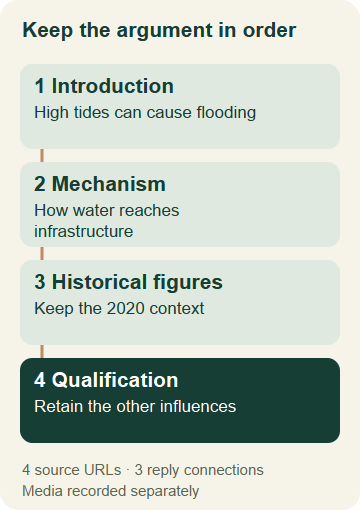
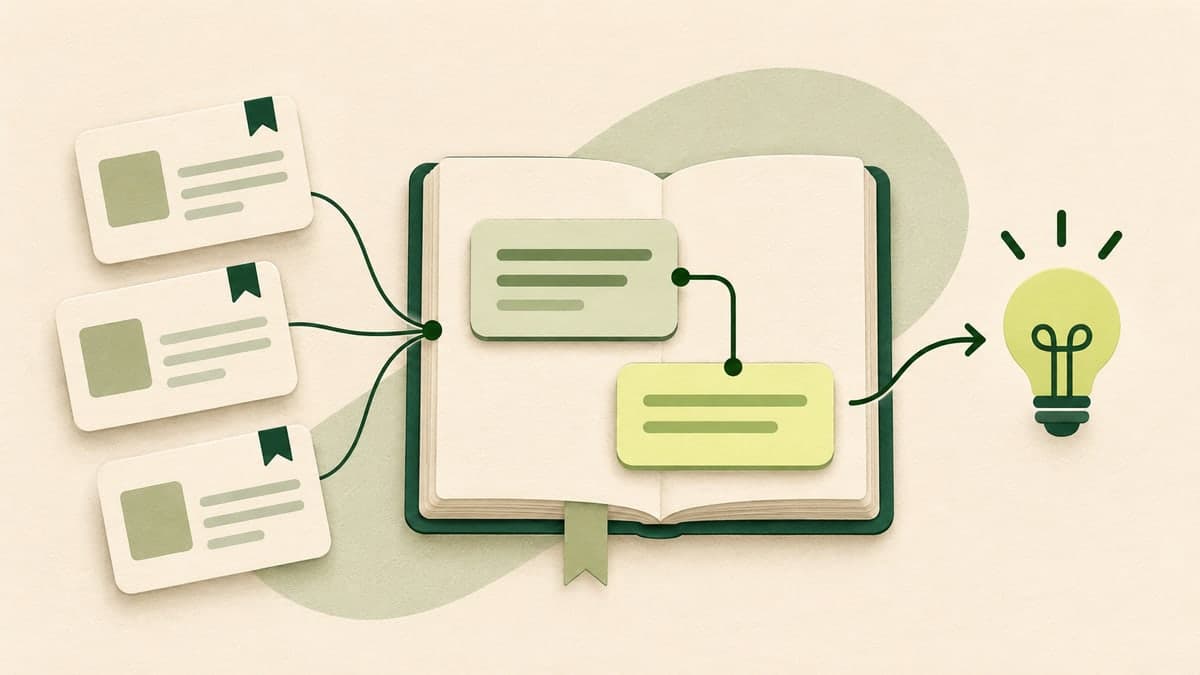
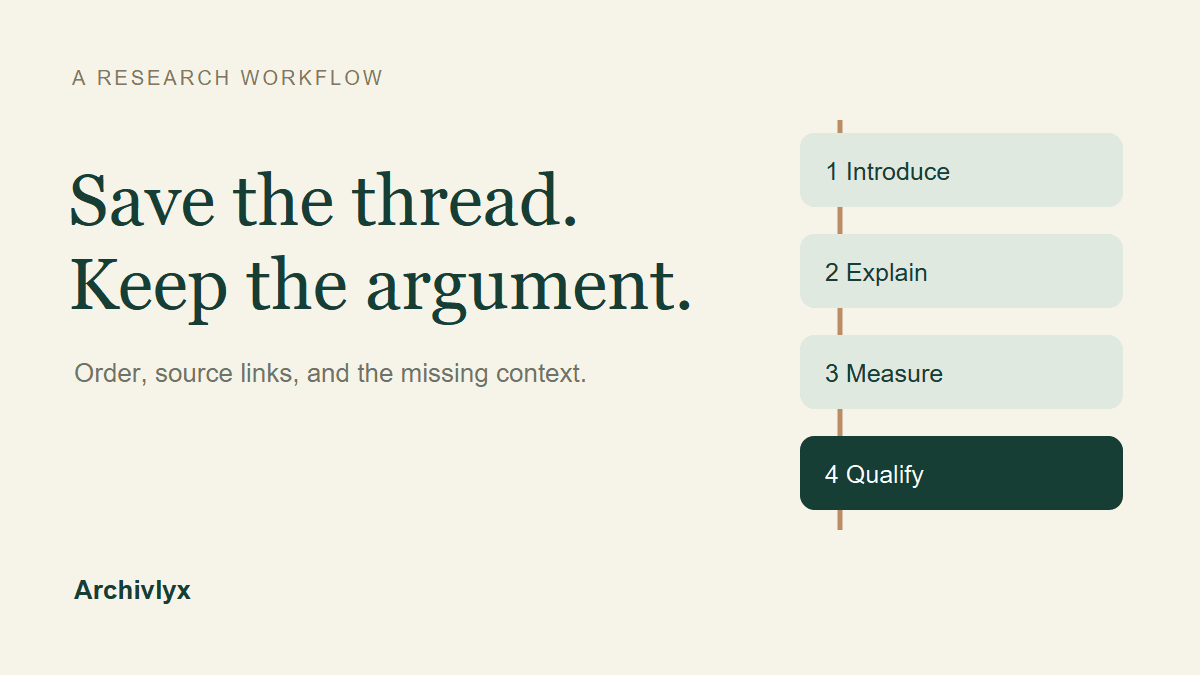
The positions are labels for our four-post research note. The diagram summarizes the checked connections; it is not an automatic thread-export screen.
Inspect each known public post in Archivlyx
Use the Archivlyx Tweet Viewer when you have a specific public post URL to inspect. Choose Tweet, paste the full link, and select Start Now. Compare the author and text before adding that item to your notes.
We used the four individual URLs in this example. Each returned NASA Earth and the corresponding post text in our current account context. The image below shows the final post, whose qualifying explanation belongs after the earlier figures.
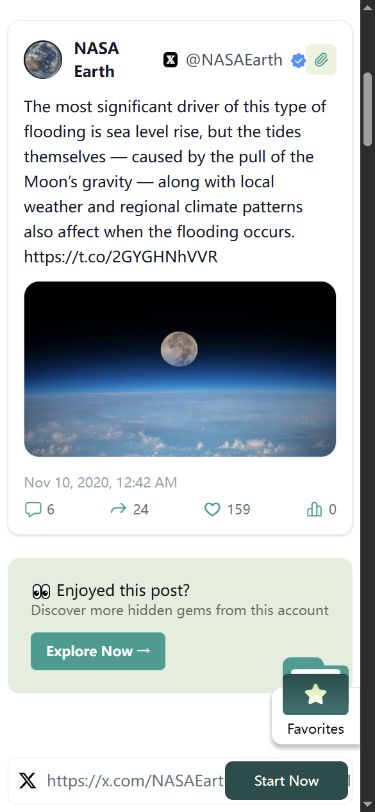
Actual product view checked on November 5, 2026. This is one known public post, not a combined export of the thread.
Use the returned content to check your candidate, then retain the original post URL in the note. Retrieving four posts one by one doesn't automatically preserve their order, replies, or files in a separate document. The ordered note is the next step, and it is a manual task.
If one item won't load, mark that position as unverified rather than replacing it with a similar post from the profile. You can still keep the available material, but the missing connection should remain visible to anyone who reads your notes later.
Build a note that keeps the argument together
Create one numbered entry per post in any text document you can keep and reopen. Record its original URL, author, a concise summary in your own words, and a date or time with its source. Where the order matters, add which preceding post it answers.
Here is the structure of our actual four-entry note:
Introduction. Distinguish storm surges from flooding caused by high tides. Source: post 1. The post contains an external video link; the video is not included in our text note.
Mechanism and consequences. Explain how water reaches streets and infrastructure. Source: post 2, which answers post 1. Its animation is referenced, rather than downloaded into the note.
Historical figures. Retain the measurements and projections in their 2020 context. Source: post 3, which answers post 2. This is historical material, not an updated 2026 measurement.
Qualification. Keep the other influences on timing alongside sea-level rise. Source: post 4, which answers post 3. Its photo remains a source reference, not an attached image file.
Those summaries are enough to recover the argument's shape without copying the entire thread. We retained four distinct URLs, four positions, and three reply connections. We also kept NASA's background article with the note so the explanation has a source beyond the social posts.
Keep your commentary separate from the author's points. A question, disagreement, or planned quotation can sit underneath an entry, clearly labeled as yours. That small separation prevents your later interpretation from being mistaken for the original post.
Check what is available offline
Close and reopen the saved text document. Check that all four positions and source URLs are present and in the intended order. In our output, that check passed. The summaries remain in the local note; following the links still depends on the original sources being accessible.
Treat media as a separate inventory. A YouTube link is not a saved video. A linked animation isn't a working offline animation, and a thumbnail isn't necessarily the image you need. For each item, write either the actual local filename you checked or a plain note such as “source link only.”
If your goal is a PDF instead, inspect both the print preview and the saved pages. Look for missing posts, cut-off paragraphs, hidden replies, and absent source links. A PDF can be convenient reading material even when it doesn't contain playable media; name that result accurately.
Leave yourself a useful return point
Finish with the date you checked the thread, the range of posts included, and any unresolved gap. If the author adds another post later, you can decide whether to extend the note without losing what your earlier version contained.
For a short research thread, the practical result is modest: an ordered argument, distinct source links, and an honest media inventory. You can cite a particular point, revisit its source, or share your note with someone else without asking them to reconstruct the conversation from a single screenshot.