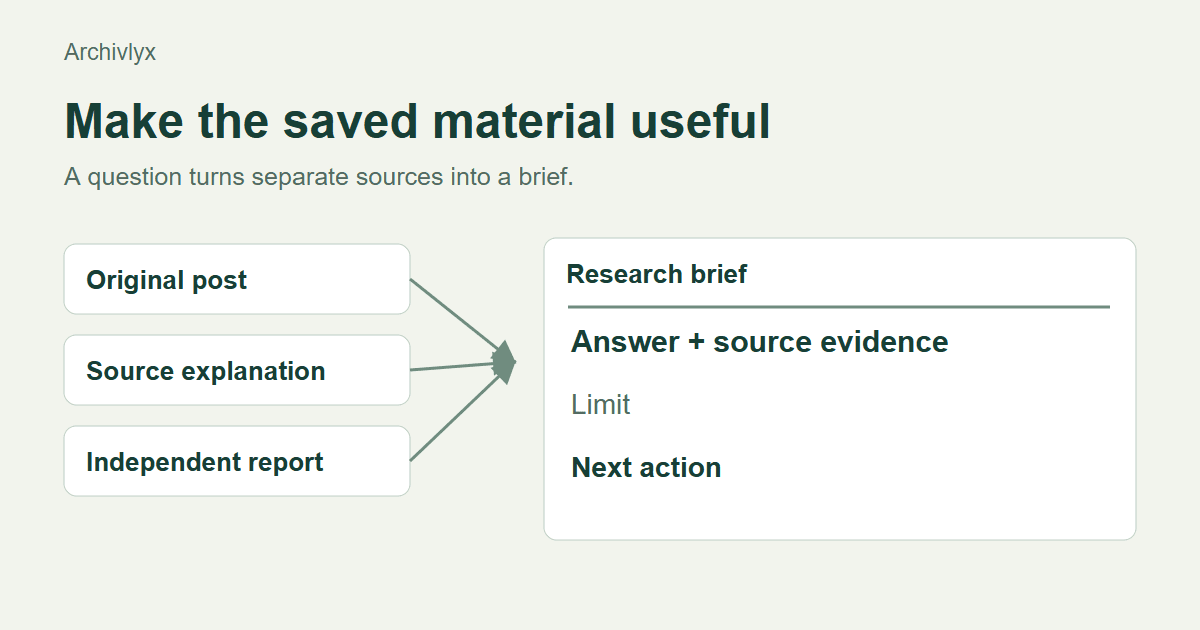
A useful research brief answers a question. A folder of saved tweets merely gives you somewhere to look. To move from one to the other, select a small set of relevant posts, open their underlying sources, and write down what the evidence supports, what it leaves open, and what you will do next.
Here is a worked example using historical material about the Ingenuity helicopter on Mars. The question is narrow enough to finish in one sitting. What evidence would let a writer say that a published clip contains sound recorded during a helicopter flight? The exercise ends with a short brief you can adapt to your own topic.
Start with a question that can change your next action
“Interesting space posts” is a collection label. “Can I describe this clip as recorded flight audio?” is a research question. The second tells you what to keep and what to investigate.
Write your question above the saved material before adding tags. Then give each item a possible role. One may contain the original announcement. Another may explain how the recording was made. A third may raise a question that the announcement does not answer.
For this example, we selected an older NASA post, the associated NASA explanation, and independent reporting. These are historical sources reviewed together for this article. Their publication dates do not describe when someone bookmarked them, and the collection is not a report of this week's news.
Open the source behind the saved post
The NASA post links a visual story to a specific claim. During our November 13, 2026 check, pasting that public URL into the Archivlyx video downloader returned its video. Opening the preview loaded the clip, and the download produced an MP4 file of 7,505,135 bytes.
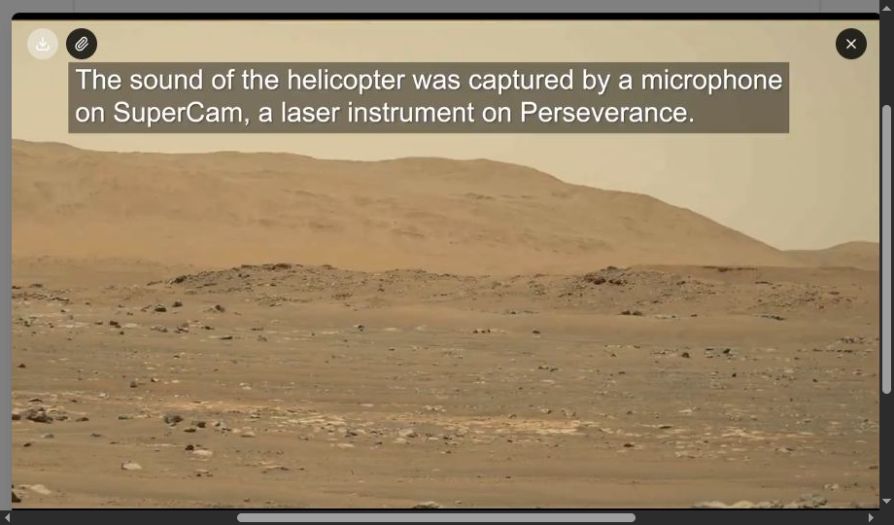
That gives us a usable local reference copy. It does not establish everything about the recording. We still need the source's explanation of the event, the equipment, and the date.
NASA's accompanying explanation identifies the sound as a recording from Ingenuity's fourth flight on April 30, 2021. It explains that Perseverance's SuperCam microphone captured the sound from about 80 meters away. The explanation was published on May 7. The event date and publication date therefore belong in separate fields.
Independent Axios reporting also covered the released recording on May 7. It adds reporting context, while NASA remains the source for the recording's technical description.
Give every saved item a job
Keep a compact source record with six fields. Copy the URL exactly, record the author or organization, distinguish publication date from event date, paraphrase the supported claim, note a limitation, and add your intended use.
For the NASA post, the intended use is locating the public announcement and associated media. For the NASA explanatory page, it is checking the recording conditions. For the independent article, it is understanding how the release was reported. Three sources serve three purposes even though they concern one event.
You can do this in a note or a spreadsheet. If your materials already live in Archivlyx Bookmarks, use the records you can actually access there as the starting collection. This example uses manually selected public URLs. It does not depend on a bookmark synchronization, export, or automatic-summary feature.
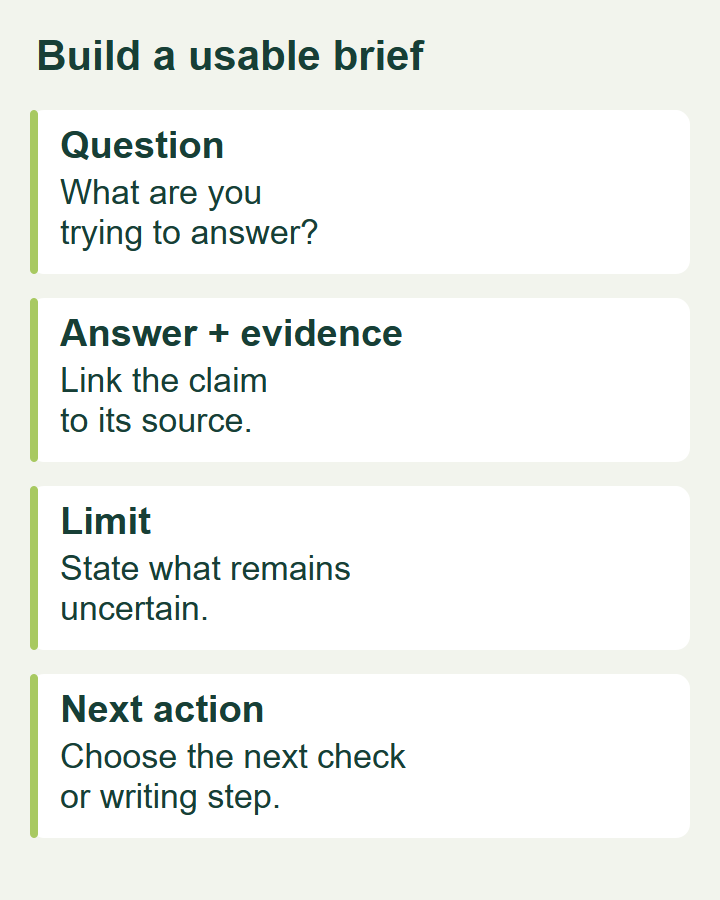
A completed brief from the example
Question. Can a writer describe the selected clip as sound recorded during an Ingenuity flight?
Answer. Yes, with attribution to NASA and the flight context. NASA identifies a recording made during the April 30, 2021 flight and released on May 7. The local media copy is useful for reviewing the material alongside that explanation.
Evidence to retain. Keep the original post URL, the explanatory page, the independent report, and the date you reviewed them. Keep the downloaded clip beside a note identifying its source.
Limit. A downloaded video alone does not establish the recording location, instrument, processing, or permission to reuse it. Those require the source documentation and the intended use to be checked separately.
Next action. Draft the sentence with attribution, link the explanation, and review the clip before choosing an illustrative frame. If a technical detail is unnecessary to that sentence, leave it in the source note.
The result is short enough to use while writing. Each statement has a place to go back to, and the remaining uncertainty has a named follow-up.
Keep the brief smaller than the collection
A brief does not need to repeat every saved passage. Move duplicates and background reading into a separate section. Keep the evidence that changes the answer in the main brief.
When sources disagree, preserve both accounts and identify the disagreement. Two headlines that repeat the same announcement do not become two independent measurements. A popular post can help you discover a topic, but its engagement count cannot settle the underlying claim.
Use quotations sparingly. A short paraphrase with a nearby source link is often easier to carry into a draft. When the exact wording matters, preserve it with the author and date. Use the citation style required by your editor or institution for that next step.
Reuse the structure for a weekly review
At the end of a reading session, choose one question you can answer from the material you saved. Fill in Question, Answer, Evidence, Limit, and Next action. Put a review date on the note so that an old collection does not quietly become current advice.
If the next action still says “read everything,” narrow the question. A good weekly review can finish with one supported paragraph and one specific follow-up. That is enough to turn the saved material into work you can continue.